A few weeks ago a group of wayward individuals met at Waterloo station. We hitched a ride on a train going north into the English wilderness. Bertrand was forward-thinking enough to have brought beers for the journey, a skill he learnt in his 10 years working for Deutsche Bank as a structured equity derivatives trader. Next to him was Ingo. Ingo does things that make my mind hurt, which involves channelling and managing innovation and systems design, in Sweden. Behind me was Neil. He works for the Young Foundation, helping to design things called Social Impact Bonds, ways of allowing private investors to get involved in financing early interventions that might reduce social malladies. He was chatting to David, who specialises in design, and in particular, new means of mapping and visualising the financial sector. Bertrand started talking about social CDOs, and that's when people on the train started to look at us funny. A girl sitting next to me asked me who we were. Um, how do you explain that? We kind of work in finance, but at the same time are trying to disrupt it, alter it, play with it. I gave her my card. "Come to the dark side", I said, "there are cool things going on". Enter the Finance Innovation Lab.
This is me, trying to talk on camera after three days of mind-disruption. We were talking financial reform and innovation, but most of all, the group of 21 of us were all together to discuss and map the potential future strategy and vision for the Finance Lab. The Lab was originally set up to bring people together under the common goal of finding out what a 'financial system that served people and planet looked like'. I'm a comparative newcomer to the group, but in the year or so that I've been hanging around I've seen the fantastic potential the Lab has to connect people, and to promote learning and collaboration. The next challenge though, is how to scale it up to the next level, to bring in new streams of funding, target more people, and incubate more projects. Jen Morgan, Charlotte Millar, Richard Spencer, Rachel Sinha, Tina Santiago, Maria Scordialos, Vanessa Reid and Hendrik Tiesinga set up the frameworks to help us to think about these questions, and then let it run. A particular discussion point concerned the extent to which the Lab should shift from its current role as a facilitating and connecting organisation, to an organisation with a more explicit focus on advocating specific policies. The process of shifting to a more political stance isn't likely to be easy, but that why Chris Hewett has come in to explore the possibilities for 'finance policy for a green economy', with support from the Gulbenkian Foundation, represented at the weekend by Louisa Hooper.
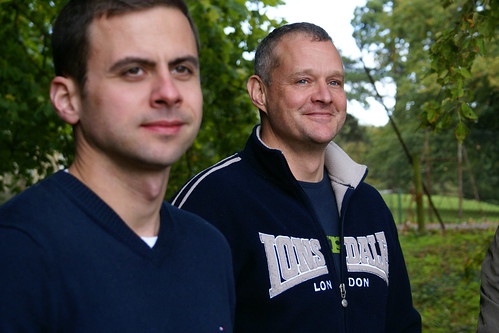
SPOT THE EX-GOLD TRADER
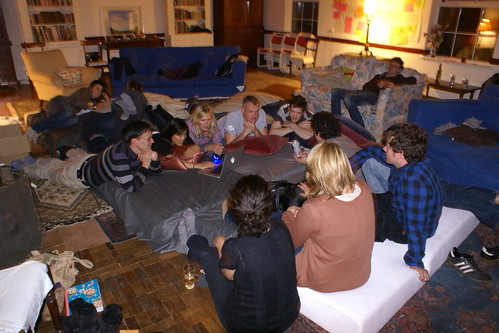
Note the beautiful setting, on the grounds of West Lexham, a fantastic enterprise on an old converted farm. Manager Edmund wants it to be a hub for community empowerment, permaculture, renewable energy and creative solutions for sustainability, so that suited us pretty well. In our crew was Niahm, a whirlwind helping to drive WWF's sustainable food initiative, Tasting the Future - concerned with issues around sustainable food systems. We had Bruce, one of the guys behind peer-to-peer lending site Zopa, and now launching Abundance, a means for retail investors to put their money directly into financing wind farms and solar energy. We had the guys interested in unorthodox monetary systems - including Ben, pushing the boundaries of the monetary reform debate, and Leander, working on nurturing the complementary currency ecosystem. I shared a room in an old piggery with Maxime, representing both France and the socially responsible investment community.
PURE INNOVATION
The Fellowship of the Ning
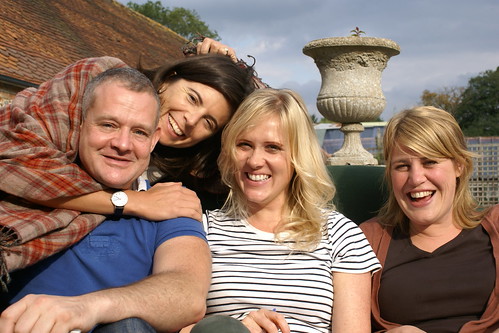
BERTRAND SHARES HIS FEELINGS
The Finance Innovation Lab is a great space for those looking to get involved in designing a sustainable financial system. The first point of contact for those who are interested in getting involved is the online network hosted by Ning, but the core team is working on setting up a new website with enhanced capabilities. The plans are grand. By 2013, I expect we should own a large part of Canary Wharf. Until then, we get our strength from diversity. It's certainly not just for financialismos. It's for anyone with an interest in sustainability, creative design, systemic thinking, chaos theory, food systems, climate change, social justice, and last but not least, all those who just like causing a little bit of havoc.
Note: I published a shorter version of this in Nesta's magazine The Long+Short as You Are the Robots . This is a modified and extended version, published under Creative Commons A banker in 1716 had two main tools: a ledger book and a quill pen. A customer – perhaps a prominent carpenter – would enter a branch, request a withdrawal or make a deposit, and the banker would make a careful note of it within the ledger, editing the customer's previous entry to keep authoritative score of exactly what the bank promised to them. ACCOUNT LEDGER BOOK OF 17th CENTURY BANKER EDWARD BACKWELL Fast-forward to 2016 and we’ve entered into a world no longer dominated by tools, but by machines . The crucial difference between a tool and a machine is that the former relies on human energy, while and the latter relies on non-human energy channelled via a system that replicates - and accentuates - the action of a human using a tool. The carpenter is now a furniture corporation using computer-program...
(Note: This is based on a talk I first gave at London Bitcoin Expo 2013 ) Imagine a scenario 10 years from now in which Bitcoin has managed to establish itself as an important global currency, supported by a myriad of Bitcoin companies, trade associations, and educational institutions. Now imagine the board meetings of those organisations. What will their demographic breakdown be? Will it resemble this , or this , or this ? It's no secret that the directorships of large FTSE 100 or S&P 500 companies are overwhelmingly dominated by men, and white men at that. This is not just due to random chance, or men's innate brilliance. This is due to our society having a lingering, systematic male bias built upon hundreds of years in which men have had the most access to job opportunities, educational opportunities, political rights, and (perhaps most importantly) cultural encouragement to actually seek those positions. This has helped men build capital, skills and to normalis...
I know what you're thinking: How on earth would I be able to read, let alone rank, 100 blogs? The answer is simple: I have a METHODOLOGY!... and it's about as scientific as a model used to work out the value of a junk-bond backed CLO. Yes, I've taken something completely subjective and added a spurious quantitative element to it. Given that this is standard practice in the financial industry, there should be no problem. The Methodology A category like 'financial blogs' is somewhat loose: I've included blogs that focus on analysis of financial news, blogs that waffle about trading and investment strategies, and more general economics blogs that provide analysis relevant to financial markets. Personal finance sites though, are excluded, so no Mint.com. The methodology is based on 3 voting rounds, during which points are scored. Let me explain... Voting round 1: The List-Makers As a starting point, I sought to identify four pre-existing 'best of' lists that...



Comments
Post a Comment